


SNE 100

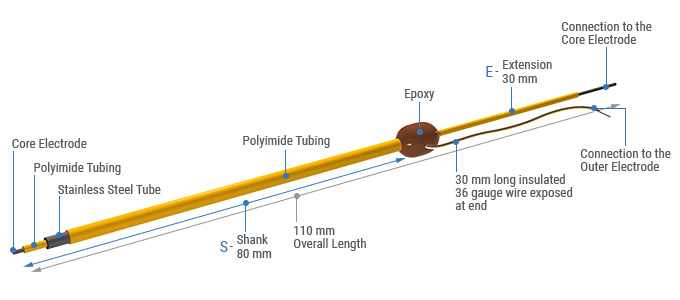
Concentric, bipolar microelectrode with NE Rhodes-Style Tip, designed for neurological recording and stimulation and are ideal for acute applications.
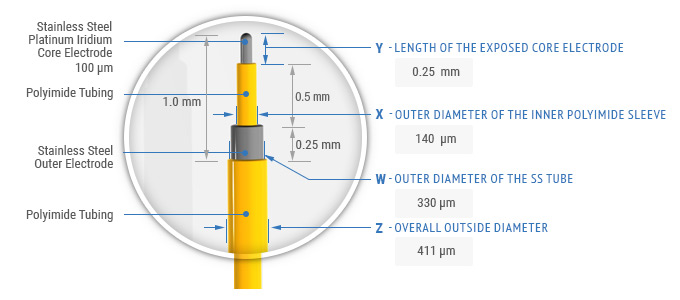
The SNE-100 is designed to replicate the Peter Rhodes-produced SNE-100 semi-micro concentric, and features the same length, thickness, and tip dimensions. These probes feature a stepped tip with well-defined element lengths, allowing surface area to be easily determined for charge density calculations. Featuring a shaft diameter considerably thinner than the NE-100, the SNE-100 is ideal for localized stimulation or population recording in fixed preparations and acute animal experiments where implant size is a critical concern.
The Stainless Steel external tubing (E) provides support for accurate placement, and manipulation during acute experiments.
Many features are fully customizable by special order, including shaft length, flexible wire length, connector type, and other features.
Stainless Steel Concentric Bipolar Electrode
|
Item |
S (mm) |
Z (µm) |
X (µm) |
Y (µm) |
Tip Diameter (µm) |
E (mm) |
5/Pkg |
|
SS-SNE-100 |
80 |
411 |
140 |
250 |
100 |
30 |
Platinum/Iridium Concentric Bipolar Electrode
|
Item |
S (mm) |
W (µm) |
X (µm) |
Y (µm) |
Tip Diameter (µm) |
E (mm) |
5/Pkg |
|
PI-SNE-100 |
80 |
411 |
140 |
250 |
100 |
30 |
Also see:
Selecting the Optimum Electrode Configuration