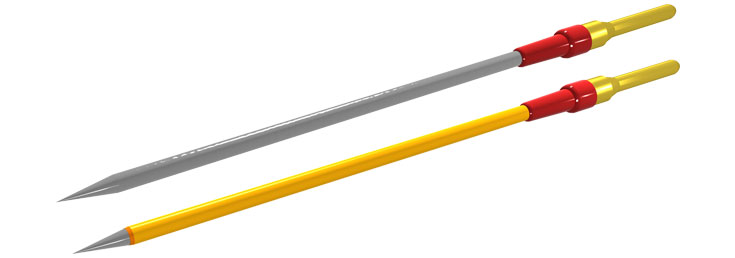
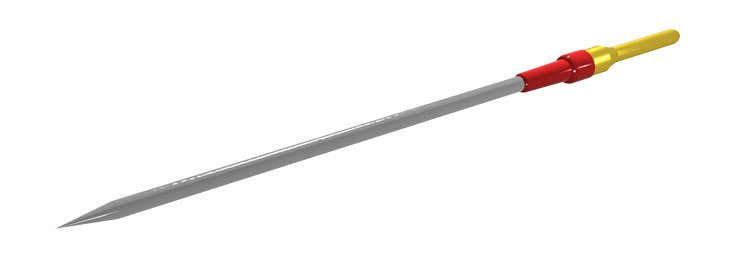
The following graph and metal selection guide will allow you to select one of four available tip profiles and the metal type most appropriate for your application.

TIP PROFILE - What tip profile is best for my application?
The tip profile is a subtle specification which will determine the ultimate success of your recording or stimulation paradigm. It is however, a microprobe parameter for which there is some debate. Many first time users will want to experiment with different tip profiles in order to see which one works best for their recording or stimulation protocols.
 |
A - Standard tip profile (25:1 Taper) |
|
H - Heat treated tapered tip profile |
|
|
F - Extra fine tip profile (40:1 Taper) |
|
|
B - Blunted tip profile (25:1 Taper) |
A Standard tip microprobes are the most widely used tip profile. It works best for most recording situations and is recommended for stimulation. The insulation at the tip of the microprobe is abruptly sheared using a proprietary high voltage arcing technique, leaving a clean exposed metal surface.
H Heat treated tapered configuration should be used mainly by those investigators who must penetrate their microprobes through tough membranes such as the dura mater of larger mammals. By applying a small local heat source near the electrode tip under a microscope we are able to provide a microprobe that has a more gradual tip profile than the "A" type. The heat treatment also will have the effect of toughening the insulation near the tip making it less likely to push back when penetrating tougher membranes. This profile is not recommended for chronic studies because the heated portion of the Parylene-C at the tip maybe unstable in the biological environment and degrade after several days or weeks of implantation causing the impedance to drop.
F Extra fine tip profile is only available in the (3" × 0.005") tungsten microprobe, WE3001X.XF series, intended for generally shallow penetrations where one requires extremely good isolation. For penetrations greater than 3 microns in which the tip impedance is greater than 1.5 MΩ the addition of polymide tubing (WE3PT1X.XF) series is recommended to reduce capacitive shunting.
B Blunted is a recent addition to our inventory as a result in feedback from many of our users. By making the tip bullet shaped the electrode's exposed length is less than it would be if it was sharp for the same impedance. Isolation can therefore be improved in some situations since the exposed tip looks more like a point source. Many investigators feel that this provides greater selectivity than the conventional sharper tip profiles and that they hold up better for heavy stimulation protocols. Some investigators have also reported that they feel there is less puncturing of cells with the blunted tips.
METAL TYPE - What metal type is best for my application?
WE Tungsten is the most versatile and widely used probe material because of it's stiffness, biocompatibility and cost. It is ideal for demanding recording situations and most stimulation protocols. Tungsten comes in a variety of lengths and widths including the very popular 127 mm (5") electrode which is used when recording from deeper structures in the brain. It is also used extensively for "Deep Brain" studies in Parkinson disease and other studies requiring an electrode configuration longer than 203 mm (8").
PI Platinum/Iridium is extremely inert and is much more resistant to corrosion than either tungsten or stainless steel when used in extensive stimulation protocols. Platinum/Iridium also has a lower concomitant tip impedance than tungsten or stainless steel and therefore has a lower tip impedance for the same amount of metal exposure. This normally equates to a higher signal to noise ratio when recording. Because it is extremely biocompatible it is an excellent selection for chronic implants.
SS Stainless Steel (Elgiloy) is widely used in doing "Vibrating Probe Studies" because of its stiffness and it can be easily electrochemically coated with other metals used in these type of studies. Our stainless steel is very unique in that it is an alloy, Elgiloy, which is used for dental implants, so it is also very corrosion resistant and biocompatible. It has also been used extensively for Prussian blue staining by passing very low dc anodal current through it for histological marking.
IR Pure Iridium is the newest addition to our line of microelectrodes. Iridium has recently found its way into many journal articles especially for chronic implants and devices being tested for potential neural prosthesis. Iridium has by far the lowest concomitant tip impedance of any of the noble metals. It is extremely inert and very resistant to corrosion. Electrochemical cyclic voltammetry has been used to "activate" the surface of electrodes to increase charge storage capabilities up to an order of magnitude over bright iridium making it an excellent stimulating electrode. A similar decrease in impedance is also effected by the activation techniques.
ELECTRODE STYLE - What Electrode configuration do I need?
Microprobes presently offers three different electrode configurations at this time, although we have fabricated many custom designs for customers in the past. As you observe what our part numbers look like for our probes, as seen under our Product section, you will notice they have a part number like WE30031.0A5. The 00 portion of the part number specifies the microprobe configuration.

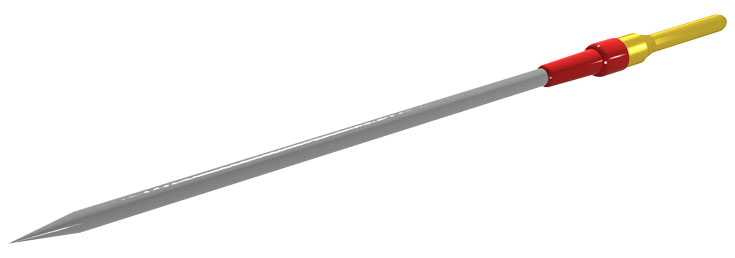
00 implies no special mounting with the sharpened probe being insulated with Parylene-C, having the length, width, tip profile and impedance as specified in the tables for ordering your electrodes.

PT are electrodes which have been mounted into polymide tubing in order to increase the stiffness and provide additional insulation thickness. This mounting is typically recommended when fairly high impedance electrodes must penetrate deeper layers of the brain or spinal cord.

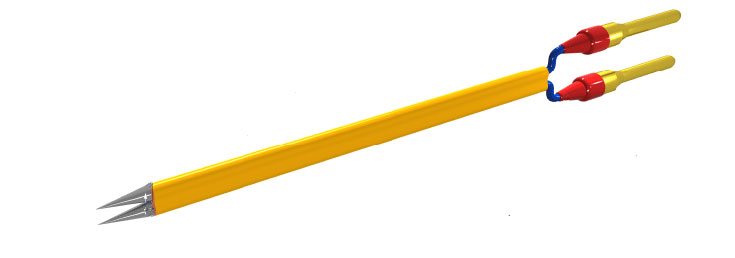
ST specifies our bipolar or stereotrodes. These electrodes when ordered with impedances less than 0.5 MΩ are excellent for localizing stimulation current fields. Higher impedance stereotrodes are excellent for enhancing the isolation of single neural elements by simultaneous recording of multiple units on two closely spaced microelectrodes. The tip spacing is typically equal to the shaft diameter of one of the electrodes used in making the stereotrode. Different tip spacing is available upon request.
These electrodes are excellent for bipolar stimulation studies where the current injection needs to be confined to a small localized part of the neural tissue. Stereotrodes have also been used for enhanced isolation of single neural elements by simultaneous recordings of multiple units on two closely spaced microelectrodes. The tip spacing is typically equal to the diameter of the electrode shaft, however, they can be specified to greater separations in most instances.
INSULATION THICKNESS - What is the insulation thickness?
All except the 76 mm (3") Extra Fine-F profile tungsten microprobe, which has a 1 micron coat of Parylene-C insulation, have 3 microns of Parylene-C. It has been proven that this thickness works best for most all electrode tip profiles we offer. MPI selected 3 microns to provide a sufficiently small tip profile for getting close to neural elements, ease of electrode insertion and to minimize attenuation for higher impedance electrodes. Attenuation of the signal can occur as a result of capacitive shunting when recording with higher impedance microprobes in deep structures, so additional insulation maybe required in the form of our PT, polymide microprobes. The F-Extra Fine profile for the 3 inch tungsten electrodes provides an extremely fine microprobe tip which is excellent when recording from small densely packed cell structures.
TIP IMPEDANCE - What tip impedance or exposure do I need?
Because of MPI´s unique fabrication process and the special properties of Parylene-C MPI is able to expose any microprobe with microscopic precision and reproducibility. Each microprobe is individually exposed under a high power microscope, inspected and electrically characterized. MPI´s microprobes have a lower impedance value for the same tip exposure as other commercially available electrodes. It is therefore recommended that those who have not used MPI´s electrodes before specify a range of impedance in order to select the best impedance value for their application. There is no additional charge for specifying a range of impedance values for any box of microprobes.
SHAFT DIAMETER - What Shaft diameter is best for my application?
MPI offers three different microprobe diameters, 76 µm (0.003"), 127 µm (0.005"), and 254 µm (0.01"). Whereas the tungsten electrodes are offered in all three diameters, Platinum/Iridium is offered in 254 µm diameter due to stiffness requirements, Stainless Steel (Elgiloy) is actually 229 µm dia. and the Pure Iridium microprobes use 76 µm dia. iridium rod. The 76 µm diameter tungsten microprobe is fairly new and was developed in response from researchers who wanted a microprobe which produced minimal tissue damage especially with regard to chronic implantation. Also many users wanted to implant a large number of microprobes within a small area where the overall size of the electrode is critical. The 127 µm microprobe is the most common size for tungsten users although many users require the heavier 254µm dia. microprobe for penetrating tougher tissue and are viewed as being slightly less fragile.

Pure Iridium or 76 µm diameter Platinum/Iridium electrode with stainless steel tubing for added length
What type of connectors are used with MPI's electrodes? The M201 pin connectors are attached to the distal end of MPI´s electrodes. You can purchase these connectors as well as the mating connector M202. Many users prefer to use MPI´s electrodes without any connector, which is fine. It is simple to remove the connectors for you if requested. There is no discount for this since the connectors are attached at the beginning of fabrication process.
Concentric Bipolar Electrodes
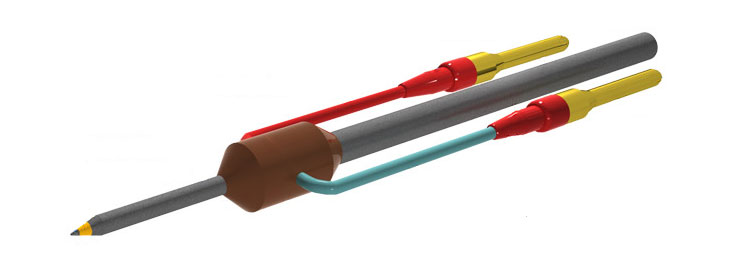
Concentric bipolar electrodes are excellent for shielded macro recording as well as evoking potentials. They are especially well suited for bipolar stimulation paradigms.

Concentric bipolar electrodes can be ordered with 76 mm (3") or 127 mm (5") long Tungsten or 51 mm (2") Platinum/Iridium core conductors. The electrode is etched to a sharp point. the outer stainless steel conductor can be specified exposed or insulated with Polymide tubing. 'W' is the overall outside diameter, 'X' is the outer diameter of the inner Polymide sleeve, and 'Y' is the length of the exposed core conductor.

Metal Microelectrodes for Vibrating Probe Studies
EMG "Patch" Electrodes
The most selective and non-damaging implantable EMG electrodes available.
Easily, securely affixed patch holds contacts in optimal bipolar configuration against desired muscle while “shielding” out cross-talk source on the opposite side.

| EP103 | single sided, | x = 3 mm | EP203 | double sided | x = 3 mm | |
| EP105 | single sided, | x = 5 mm | EP205 | double sided | x = 5 mm |
Special designs quoted on request - send sketch.
Custom options include multiple contacts on one or both sides, special orientations and intervals.
Related Products:
|
Metal Electrodes, monopolar(MicroProbes) |
Bipolar Metal Electrodes (Stereotrodes)(MicroProbes) |
Concentric Bipolar Metal Electrodes(MicroProbes) |
|
Electrodes for Vibrating Probe Studies(MicroProbes) |
Macroelectrodes(MicroProbes) |
|