|
TemperatureProbes
|

|
|
Small,
Fast and Accurate Temperature Probes |
physitemp
|
|
| ---- |
|
|
|
Physitemp's
miniature Type T thermocouple sensors provide the wide stand most versatile
selection of temperature probes available for bioscience and analytical
chemistry applications. All clinical probes and microprobes are made
with Physitemp's proprietary copper-constantan thermocouple wire and are
guaranteed accurate to 0.1°C within the physiological range. All probes are
interchangeable and do not require individual calibration when used with any
of our Type T thermocouple instruments.
Physitemp's
tiny sensors, welded under microscopes, are used to make needle probes as
small as 29 gauge and flexible probes with a diameter of .005". Small
mass results in fast response times, with time constants as low as .005
seconds.
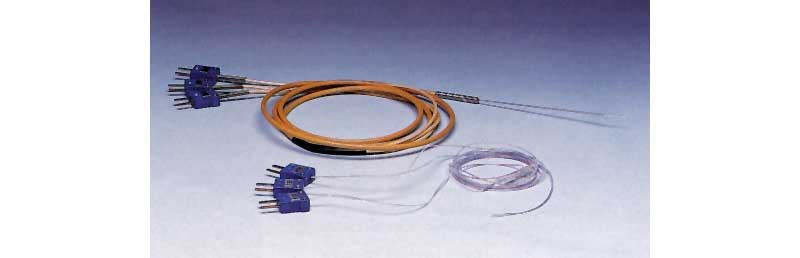
Physitemp's
best selling probes, the flexible 1T- 18
series, are used in many scientific and industrial applications; for
implantation in tissue, in spectrophotometer cuvettes, rectally in neonatal
mice, and in water baths. They are fast reading, strong, completely sealed in
flexible Teflon® and may be sterilized by gas (ETO) or autoclave.
Stainless
steel needle probes as small as .033mm
diameter are available. There are surface probes, animal rectal probes in
several sizes, heavy duty probes and a wide range of clinical probes. Physitemp
also make custom probes in any quantity including multisensor microprobes
with as many as 10 sensors.
|
|
|
High
accuracy is guaranteed
Physitemp
specializes in the manufacture of Type T (copper-constantan) thermocouples.
Small, flexible sensors are in demand for use in medical applications where
high accuracy and interchangeability are required. Type T wire is widely
recognized as being the most suitable thermocouple for these applications.
Accuracy
of ±0.l°C in the physiological range is possible and the probes are
completely interchangeable. Wire with only ±0.5°C accuracy is readily
available. This is known as "Special Limits" wire. Physitemp is a
supplier of the premium grade with accuracy to 0.l°C.
Advantages
of Thermocouples
There
are currently six different common techniques for measuring temperature :
thermal expansion, such as the bimetallic
strip or liquid-in-glass thermometers, bulk resistance devices such
as platinum RTD's and thermistors, semiconductor devices including diodes
and transistors, thermocouples, liquid crystals and infrared noncontact
devices. Of all the contact measurements techniques listed above the
thermocouple is the smallest in size, fastest responding and lowest cost.
This offers the least perturbation to the object being measured, and hence,
the most accurate interpretation of its temperature. Their wide operating
range and low relative cost make thermocouples ideal for most bioscience and
industrial applications.
What
are thermocouples ?
A
thermocouple is a junction of two dissimilar metals and exhibits galvanic
activity in response to a temperature gradient across the junction. Many
conductors exhibit this effect, however in practice only eight or nine
different types of thermocouples are used extensively in a vast array of
industrial, commercial, medical and research applications. Selection of a
thermocouple e for a specific application is related to cost, temperature
range, accuracy, stability and operational life expectancy.
A thermocouple sensor is created wherever the wires comprised of the two
dissimilar metals are joined together electrically.
The
junction is usually a welded connection because this minimizes the size of
the junction and provides the fastest response time. In addition, because
the weld melts at such a high temperature it enable s the probe to be used
over a much wider temperature range. The sensor may also be formed by
soldering or crimping, neither of which will affect the accuracy of the
junction in measuring temperature although the response time may be slower
and the melting point and corrosion resistance of the sensor junction may
suffer when soldered. Since most of
Physitemp's
thermocouples are made under a microscope, the quality and consistency of
each weld is very high.
Isolated
vs. Non-isolated
In
a non-isolated sensor, the thermocouple bead is in direct contact with the
object being measured, or it is in electrical contact with an outer and
electrically conductive sheath that is in contact with the object. The
advantage of the non-isolated sensor is the improved response time in both
the sheathed and unsheathed forms.
An
isolated sensor may be needed in an electrical application or one in which
more than one sensor is present in a conductive medium. If the object being
measured is electrically conductive and at an elevated potential, it is
especially important in order to prevent an electric shock to the operator
or damage to the measuring instrument.
In
many medical applications invasive sensors may be in contact with internal
body fluids which are comprised of conductive electrolytes. Isolated sensors
are required in these applications to avoid galvanic interaction between
temperature sensors and other types of electrical sensors such as EKG
electrodes.
|
|
|
PDF-
File Temperature
C&M Systems
Catalog
F
Products
|
|
|
General Purpose Probes
|
|
|
|
|
|
|
|
|
|
HT-1
“Workhorse” Probe for liquids, gases semi-solids.
Plastic handle with straight 3” stainless shaft. Not good for
surface temps. Max.
Tem. 400°C. Time constant 0.5 secs. 5ft.lead.
Not isolated.
HT-2 As HT-l but with 9" shaft.
|
|
|
|
BT-1
For surface temperatures of solids, also for liquids, gases
and semi-solids. Probably our best general purpose probe.
Welded stainless-steel shaft, plastic handle. Tip is 0.028"
diameter bent at
right angle to probe to facilitate accurate surface
measurements. 5 ft. lead. Immersible. Max tip temp. 240°C. Time
constant
|
|
|
|
DPT
Series Immersion probes for liquid. #304 stainless steel
welded shaft, wooden handle. 5 ft. lead. Max. Temp. 400°C
. Time constant 2 secs. Not isolated. TFT
Series - Immersion probes for corrosive liquids. Similar to
DPT series but shaft is Teflon-coated Max. Temp. 150°C
|
|
|
|
PT-6
Sensor Six-Pack. For multi-point measurements.
Inexpensive, flexible. Welded sensor beads, tough Kapton
insulation, 5 ft. leads. Max. Temp. 400°C. Time constant 0.01
secs. Per package of six. Not isolated.
|
|
|
|
GT-1 Air and gas probe. 24" #304 stainless steel shaft, wooden
handle. 5ft. lead. For instant readings of temperature
gradients in environmental chambers, freezer boxes, etc. Max
Temp. 200°C.
Min.
Temp. –200°C. Isolated.
|
|
|
|
Clinical Probes
|
|
|
|
RET-1
Rectal probe for humans, neonatal rabbits, and larger animals.
Flexible, vinyl covered, soft tipped. Does not cause discomfort.
Max. Temp. 90°C. Time constant 5.0 secs. 5 ft. lead. Isolated.
|
|
|
|
OT-1
For fast reading oral use. Ball-tipped stainless steel shaft,
stainless handle. 5 ft. lead. Max. Temp. 125°C. Time
constant 0.8 secs. Not isolated.
|
|
|
|
DSP-1 Disposable sterile sheaths for use with OT-1 and RET-1, per
1000
|
|
|
|
SST-1 Skin Surface probe, to be taped on.1/4" dia. 10 Kt. gold
sensor disc, 5 ft. lead. Max. Temp. 90°C. Time constant
0.15 secs.
Not isolated.
|
|
|
|
SST-2
as SST-1 with plastic handlel.
Isolated.
|
|
|
|
ESO-1 Esophageal probe. Flexible vinyl covered 1/8" dia. Max.
Temp. 90°C. Time constant 5.0 secs. 5 ft. lead. Isolated.
|
|
|
|
Animal Rectal Probes
|
|
|
|
RET-2
Rectal probe for rats. For fast intermittent measurements.
Smooth ball tip. Stainless steel
shaft - 1" long. 0.059"
dia. Tip diameter 0.125". 5
ft. lead. Max Temp. 125°C. Time constant 0.8 secs. Not
lsolated.
RET-3 Rectal probe for mice, etc. As RET-2, with shaft 3/4"
long.
0.028" dia. Tip diameter 0.065". Time
constant 0.5 secs. Not isolated.
|
|
|
|
Time
constant is defined as the time required to reach 63% of final
temperature in liquid. An accurate reading is obtained when the
reading stops changing, typically 5-10 time constants.
Maximum
Temperature refers to intermittent use of a probe. When probe is
used for continuous measurements, max. temp. should be reduced by 25%
unless specified.
|
|
|
PDF-
File Temperature
C&M Systems
Catalog
F
Products
|
|
|
Microprobes
|
|
|
|

Type Dia.
Time
Constant
MT-23
23 ga (.25”)
.15 secs
MT-26 26 ga (.18”)
.1
secs
MT-29 23 ga (.13”)
.025 secs
|
Needle
Microprobes
Fast-response
needle probes for instant readings in tissue, semi-solids,
liquids. Also for very small specimens, powders and materials.
Needle tip is sealed to ensure only stainless steel contacts
specimen. Max.
Temp. 200øC. SFT.
lead. Smallest microprobes give fastest reading. Short probes
are easier to insert and last longer. Type #'s indicate
needle gauge and needle length in cm.
Sizes Available (ga/cm,):
MT-29/1, MT-29/2, MT-29/3, MT-29/5
MT-26/2, MT-26/4,
MT-26/6
MT-23/3, MT-23/5, MT-23/8
MT – 4
Similar to MT-29/1 but has blunt tip. Good for instant skin
and surface temperatures, liquids. Time constant
0.025 secs. Not isolated. All
above probes are non-isolated. Isolated versions of 23 ga. and
larger needles are available for special
order.
|
|
|

|
Flexible
Implantable Microprobes
IT Series
- Implantable in semi-solids and tissue with needle (supplied).Also for immersion in various solutions and rectal temperatures
of small animals. Totally sheathed in chemical resistant Teflon™.
Quite rugged. Max. Temp. 150°C. lsolated. Type # designates needle gauge
(or one gauge smaller in thin wall).
Type
Dia.
Time Constant
Lead Length
MT-23
23 ga (.25”)
.15 secs
3 ft.
MT-26
26 ga
(.18”)
.1
secs
3 ft.
MT-29
23 ga
(.13”)
.025 secs
1
ft
|
|
|
|
IT-23
- For ultra fast measurements and for use on micro-size
specimens.
Max.
diameter at tip 0.011". Tissue implantable with 23 ga.
needle (supplied). Rather fragile. Max. Temp. 150°C. Time
constant 0.005 secs. 3 ft. lead. Teflon™ coated. lsolated. - For ultra fast measurements and for use on micro-size
specimens.
Max.
diameter at tip 0.011". Tissue implantable with 23 ga.
needle (supplied). Rather fragile. Max. Temp. 150°C. Time
constant 0.005 secs. 3 ft. lead. Teflon™ coated. lsolated.
|
|
|
|
IT-IE
- As IT-18 but sensor bead exposed. Combines the ultra-fast
response of IT-23 with the Teflon™ sheath strength of IT-18.
Time constant .005 secs. lsolated.
|
|
|
|
MT-D
- Fast response surface probe for locating inflammation,
arteries, etc. Also
for dental use. Stainless steel. 5 ft. lead. Max.
Temp. 200°C.
Time
constant 0.025 secs. Not isolated.
|
|
|
|
ICT-4
- For use on integrated circuits and other micro specimens.
0.013" dia.
straight stainless steel shaft; slightly protruding sensor bead
to facilitate temperature probing. 5" tubular handle fits
micro-manipulators. Max. intermittent temp. 200° C, continuous
use 100°C. Time constant 0.025
secs. 5 ft. lead. Not lsolated.
|
|
|
|
MT-29/1B
- Insect Probe Similar to MT-29/1 but sensor is swaged into
tip for max heat transfer. Designed for high accuracy on
extremely small specimens such as insects, seeds, etc. Max.
insertion depth 1/8" Time constant 0.015 secs. 5 ft. lead.
Max. Temp. 150°C. Other sizes made to special order. Not
isolated.
|
|
|
Probe
sterilization Methods Physitemp's needle microprobes, clinical probes and
animal rectal probes are all designed to withstand sterilization by ETO gas
and gluteraldehyde solution. Our flexible implantable microprobes are both
ETO gas sterilizable and autoclavable.
|
|
|
PDF-
File Temperature
C&M Systems
Catalog
F
Products
|
|
|
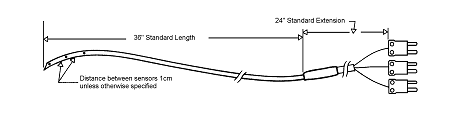
Multisensor Probes
|
|
|
¤ Up to 10 sensors in one probe
¤ Use to profile temperature of tumor
or other tissue
¤
Conform to NIST standards
|
|
|
Physitemp multisensors are made with our specially manufactured thermocouple
wire. We test and grade this wire to standards better than the accepted
"Special Limits of Error" and guarantee 0.1°C accuracy in the
range of 0-50°C. All multisensor probes conform to NIST standards. These
multisensor probes are custom made and should be ordered to your
requirements on number of sensors and spacing between sensors.
Most
common applications have been for cancer
hyperthermia, where tissue temperature is an important clinical variable.
Physitemp
use two different design techniques for
the manufacture of the 1T Series Flexible teflon probes. Each method
has advantages :
In
METHOD A, two individual wires (one copper,
one constantan) are used for each sensor. Sensors can be as close as 5 mm
apart.
In
METHOD B, a single common constantan wire is used. Separate copper wires are
then connected to different points along the constantan wire to form the
sensors. With this method, the probe can be made at least one gauge thinner
and errors due to wire conduction are reduced. Sensors must be no closer
than 5 mm apart.
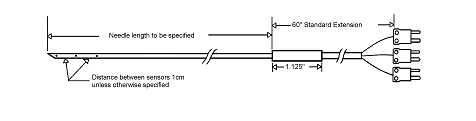
Multisensor
needle probes can be made with
either isolated or non-isolated sensors.
Please
specify when ordering.
Note:
Probe length is 60" maximum. Shorter lengths can be made. To extend to
distance between probe and readout, order 6 foot extension lead EXT-6
.
|
|
|
|
|
|
1T
Series Flexible Teflon® Probes
|
|
|
Teflon®
sheathed thermocouple wires are implanted with regular hypodermic needle
14ga. or 17ga.
When
ordering, specify: Probe series (IT), needle gauge, number sensors and
distance between sensors. We can put up to 10 sensors in a IT series probe.

e.g.
MT-2315(2)1 is a 23ga needle, 5cm long with 2 sensors -isolated. Unless
otherwise specified, sensors will be 1 cm apart, starting at tip.
|
|
|
PDF-
File Temperature
C&M Systems
Catalog
F
Products
|
|