


VC-77CSP

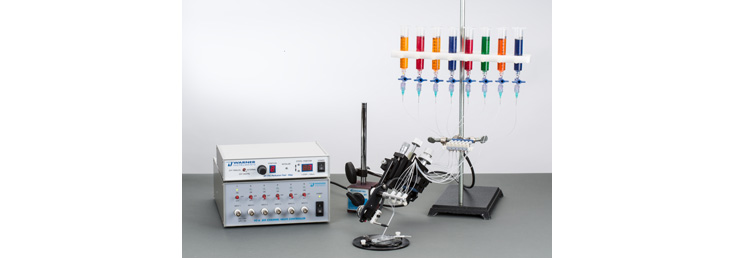
This perfusion system is the combination of a Warner Mini-perfusion Valve Control System and the SF-77C Fast Step Perfusion System
The VC-77CSP is a unique system which enables the user to rapidly select between several perfusion reservoirs, saving time and effort. The system is comprised of the VC-66MCS Valve Control System and the SF-77C Perfusion Fast Step.
The SF-77C Perfusion Fast Step rapidly delivers solutions to a sample and the VC-6M/ VC-8M Valve Control System provides the ability to change the solution flowing out of any one of the stepper outflow tubes. Combining these two systems together in the VC-77 Perfusion Fast-Step System enables the user to rapidly select between several perfusion reservoirs, saving time and effort.
The SF-77C is designed around the 'sewer pipe' concept which requires that all solutions flow simultaneously, and at the same relatively velocity, out of all the tubes within the stepper mechanism. The matched-velocity flow prevents mixing between adjacent outflows despite all of the solutions being simultaneously introduced into the bath. This approach allows the sample to see a 'pure' solution emitting specifically from the desired outflow tube.
Bath vs Stepper solution flows
It's important to note that in addition to managing solution flow out of the SF-77C perfusion tubes, the flow within the larger chamber also needs to be managed since all flow velocities need to be the same.
A properly configured system will have a standard valve control system (such as the VC-8P) dedicated to controlling the main bath flow, and a separate, smaller valve control system (such as the VC-6M) dedicated to managing solution flow within the SF-77C perfusion tubes.
Having separate valve control systems for these two paths is critical for proper operation since the relative volumes and flow rates between the two are dramatically different and one controller cannot service both demands simultaneously.
Fortunately, most users already have a solution delivery system in place dedicated to servicing the larger chamber bath, and the VC-77C package provides the needed mini valve control system for the SF-77C.
VC-77C
The main use of the SF-77C is to provide rapid solution change at a single cell or membrane patch attached to a patch electrode. This is typically achieved using a three square barrel piping system, although up to five single barrels or two barrel Theta glass tubing can be easily accommodated.
As is described on the SF-77C page, the Fast-Step rapidly changes the solution appearing on the sample by mechanically performng a side-to-side shift of the position of the associated delivery tubes. Control and test solutions flow continuously through adjacent delivery tubes, and the stepper mechanism selects which tube is directed at the preparation.
The rapid response and nominal hysteresis of the stepper allows for very short switching times and solution changes can be achieved in as little as 20-50 ms (or even as fast as ~1 ms when using a two-barrel Theta tubing). Once changed, the new solution with its specific concentration of salts or pharmacological reagent will remain stable until changed again.
The VC-6M or VC-8M valve control system lies at the heart of a multi-valve perfusion system designed to automate and control the delivery of small quantities of fluids to the SF-77C.
The controller can independently regulate the function of up to six valves. Individual valves can be controlled via a manual switch or an external digital (TTL) signal. Valve transitions (opened or closed) occur at full power to insure rapid response times and are then held in place at less than half power to prevent heat transfer to solutions. An event-marker pulse, generated each time a valve is switched on, is provided at the rear of the controller for recording into your acquisition system.
VC-77CSP - with 6 channel valve control system
The system includes:
- VC-66MCS - Complete 6 channel mini-valve perfusion system
- SF-77C - Perfusion Fast Step
- MM-33R - Right handed Micromanipulator
- MBB - Magnetic Base
VC-77CSP8 - with 8 channel valve control system
The system includes:
- VC-8M - Complete 8 channel mini-valve perfusion system
- SF-77C - Perfusion Fast Step
- MM-33R - Right handed Micromanipulator
- MBB - Magnetic Base
Solution changes can be made in as little as 20-50 ms (or as little as ≈ 1 ms using a two-barrel Theta tubing), and once changed the new solution with its specific concentration of pharmacological agent will remain stable until changed again.
An important capability of this device is that a large number of solutions can be used during the course of a single experiment, regardless of the compact size of the device. This creates the ability to use 15-30 different solutions in a single experiment. This feat is accomplished by having as many as six solutions feeding through a unique manifold into each of the three "pipes" in front of which the cell may be placed. This allows any of the three pipes to have any one of six solutions flowing through it at any time. It is even possible, during the course of an experiment, to change the six solutions flowing into any one of the manifolds, allowing a virtually limitless number of solutions to be used.
The VC-6M Valve Control System lies at the heart of a multi-valve perfusion system designed to automate and control the delivery of small quantities of fluids to Warner Instruments imaging and recording chambers. However, its flexible design allows the system to be used in many applications not using Warner equipment. The miniature solenoid valve assembly is standard with the system. They are lightweight and made from rugged materials for long life.
Valves are dual acting with both normally open and normally closed sides. The normally open side is plugged with removable stoppers and when these are removed solution can flow to waste while the valve is in the off position.
The controller can independently regulate the function of up to six valves. Individual valves can be controlled via a manual switch or an external digital (TTL) signal. Valve transitions (opened or closed) occur at full power to insure rapid response times and are then held in place at less than half power to prevent heat transfer to solutions. An event-marker pulse, generated each time a valve is switched on, is provided at the rear of the controller for recording into your acquisition system.
Specifications: Six- or Eight-Channel Mini-Valves
Valves 12 V DC /0.046 A, solenoid type
Valve manifold Teflon material, mounts on a 3/8" or 1/2" ring stand
Tubing PE-50
Connection Cable 2.4 meter (8 ft.) connecting cable terminated with quick disconnects on valve end and 15 pin male "D" type connector on controller end.
Reservoirs 10 cc capacity syringes
Reservoir Holder Delrin. Holds eight syringes with thumb screws for each reservoir.
Valve Controller Typical response times for valves is 2.5 ms
Switch Selection Manual, Off or External
External Input +5 V TTL-compatible (BNC Connector)
Event Marker Logic level pulse 500 ms nominal (rear panel BNC connector)
Manifold 2-to-1, 4-to-1, or 6-to-1. Nominal dead space
Power 110 - 130 or 200 - 250 V AC, single-phase, 50/60 Hz, 20 W
Operating Temperature 10 - 40 °C (50 - 104 °F)
Dimensions (H × W × D) 89 × 203 × 305 mm (3.5 × 8.0 × 12 in.)
Number of Steps 1 to 7
Step Size Adjustable from 100 µm to 1.5 mm in 100 µm increments
Step Speed Typically 20 ms for 700 µm step
Step Control
Manual 8 positions with POSITION selector
Analog Signal 8 positions with voltage levels 0-7 V, 1V per step
Digital Signal 8 positions with 3 bit TTL signal
Max. Stepped Range 12.0 mm
Mounting Handle 6.3 mm × 10 cm (D × L)
Stepper Weight 110.5 g (including handle)
Solution Manifolds Three manifolds supplied with each system:
MM series for SF-77C and SF-77CST
ML series with SF-77CLT
One 2-input and two 6-input manifolds are supplied
MM Series MM series manifolds use PE-50 tubing at input and PE-10 tubing at output
ML Series ML Series manifolds use PE-50 tubing at both input and output
Solution Flow Rates Rates measured with solution reservoir height of approx. 60 cm (24 in)
With MM Series 100 µl/min
With ML Series 1 ml/min
Control Box
Size, H × W × D 5.0 × 21.2 × 19 cm
Power 120-240 VAC, 50/60 Hz, 10 VA
Shipping Weight 2.7 kg
Warranty 2 years, parts and labor