


P-97



The Model P-97 micropipette puller is a Flaming/Brown type puller for fabrication of micropipettes, patch pipettes and microinjection needles. While retaining many of the features found on the Model P-87, the P-97 offers improvements in the mechanical, electronic and software design. The result is better control of the pulling process and a higher degree of reproducibility.
The P-97 combines a proven mechanical system with a sophisticated, programmable microprocessor controller. This programmable control of the pulling parameters allows the investigator to design application specific pipettes from a wide range of glass compositions and sizes.
A number of new features have been incorporated in the design of the P-97. One of the most apparent is the environmental chamber which houses the area surrounding the heating filament. The humidity control chamber is designed to minimize the effect of changing humidity on the reproducibility of pulled pipettes. A 25 % increase in power over the previous version allows for the use of larger heating filaments, larger diameter glass and multibarreled glass. The metal jaws that clamp the heating filament have also been redesigned to minimize heat retention. A gas delivery mode switch provides for extended cooling for large diameter and multibarreled glass. A springloaded clamping mechanism has been added for easier loading of glass. A vacuum fluorescent display has been added that allows easy viewing from any direction.
New software improvements include a display of the total time that the heat is on to assist in program development and troubleshooting. Up to 100 programs can now be written and stored in memory, which makes the P-97 more useful for multiple users. These programs can now be write-protected; this added security prevents programs from being changed or altered inadvertently. When a program is written and saved it includes the date that it was written or edited. The air pressure is included as a programmable item.
The velocity of the glass carrying system is measured as the glass softens and begins to draw apart under a constant load. The increasing velocity of the initial pull is determined by the viscosity of the glass, which in turn is a function of the glass temperature. The adjustable velocity allows for selection of a precise glass temperature as the point at which the hard pull is tripped. The puller operates on the principle of rapid cooling of the heating filament to give fine tipped pipettes with extremely short tapers, thereby producing stiff microelectrodes suitable for beveling. Other benefits of the short taper are reduced tip resistance and decreased capacitive coupling in twobarreled microelectrodes.
The P-97 contains a ramp-test to overcome the difficulties of program adjustment when a new filament is installed or to help characterize a new glass/filament combination. This test allows for the rapid adjustment of heat values in established programs and provides estimates for establishing heat settings when using new sizes or compositions of glass capillaries.
As with all Sutter Instruments, the electronics have been carefully designed to maximize noise rejection.
Features
- Humidity control chamber
- Programmable air pressure
- Up to 100 programs can be written and stored
- Write protection lock and date stamp
- Two symmetrical pipettes with each pull
- Preprogrammed sample programs for intracellular and patch pipettes
- Special programming on request
- Ramp test-self test for establishing program heat settings when a new filament or glass is introduced
- Constant current power supply for filament and pull solenoid
- Looping pull cycle for fabrication of patch type micropipettes
- Vacuum fluorescent display
- Self-contained air supply with humidity control and built-in filtration system
- Consistent and reliable electrodes with tip diameters less than 0.1 µm
- Control over the time and pressure at which the air is delivered
- Internal memory test
- Optimized velocity sensing circuit for maximized sensitivity and reproducibility
- Quality control, SEM photograph of a tip pulled with each puller; criterion is tip measurement less than 0.1 µm and typically is ≈ 0.06 µm
Specifications
Dimensions 53 cm × 36 cm × 30 cm
Weight 28 kg
Electrical 115/230 V, 50/60 Hz
References
These references describe the Flaming/Brown series of pullers and contain valuable information applicable to the P-97.
- Brown, K.T. and Flaming, D.G. Neurosciences Journal 2:813-827,1977.
- Flaming, D.G. and Brown, K.T., Journal of Neuroscience Methods 6:91-102. 1982.
- Brown, K.T. and Flaming, D.G., Advanced Micropipette Techniques for Cell Physiology. John Wiley and Sons. Great Britain, 1986. (Available via Science Products!)
Also See:
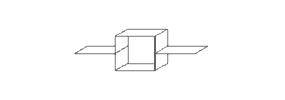
Box Filaments
for Micropipette Pullers
P-1000, P-97, etc.
(Sutter Instrument)
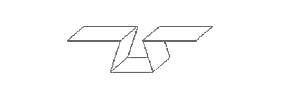
Trough Heating Filaments
for Micropipette Pullers
P-1000, P-97, etc.
(Sutter Instrument)
Accessories
for all
Sutter Instrument
Micropipette Pullers