


Model 1800

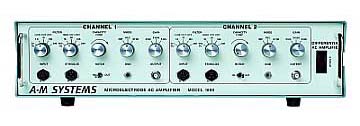
The Microelectrode AC Amplifier (Model 1800) is a two-channel, differential amplifier with head stage probes that are intended for extracellular recording and/or stimulating with microelectrodes. This Instrument is designed to work with high impedance metal microelectrodes in research and teaching applications. Extracellular neurophysiological recordings with high impedance microelectrodes can easily be done from excitable tissues such as nerve and muscle. The Instrument is not intended for clinical measurements using human subjects.
Features
- Metal microelectrode amplifier
- Two amplifiers in one instrument
- Two head stage probes
- Low cost
- Recording gains: ×100, ×1000 or ×10 000
- Low noise (25 µV peak to peak 10 Hz -10 kHz)
- High common-mode rejection (>70 dB @ 60 Hz)
- High line frequency rejection with notch filter (>110 dB @ 60 Hz) (50 Hz optional)
- High input impedance (100 000 MΩ )
- Low input bias current (100 pA typical; 300 pA maximum)
- Adjustable low and high frequency filters
- Power: 110 V AC @ 60 Hz (230 V AC @ 50 Hz)
Specifications
MODE SELECTION This switch allows the user to select one of three Modes for each channel of the amplifier: IMP Mode (Impedance Check), REC Mode (Record), and STIM Mode (Stimulate). During Impedance Check, an internal 1 kHz oscillator automatically applies a calibrated current through the electrode and the amplifier monitors the voltage in order to check impedance.
CAPACITY This control is used to neutralize capacitance during the electrode impedance check. The output signal is 100 mV per MΩ . In the Record Mode, the Instrument amplifies the differential input signal by an amount selected by the GAIN switch. In the Stimulate Mode, a stimulus is applied directly to the electrode through the STIMULUS connector, and the amplifier monitors the current passing through the electrode. Output signal is 100 mV per µA.
GAIN SELECTION In the Record Mode, the gain of each amplifier may be independently set by adjusting the GAIN switch to ×100, ×1000, or ×10,000.
Physical Dimensions: 43.2 cm × 12.1 cm × 28.6 cm
AC Power: This is the standard power source. Either 110 V/AC or 220 V/AC may be used.
Line frequency: 60 Hz standard, 50 Hz optional (no extra cost). These are set at the factory and must be indicated at the time the order is placed.
HEAD STAGE
Input: 2.0 mm female pin connector
Body: 1.36 cm diameter × 10.2 cm length
Mounting Rod: 4.7 mm diameter × 9.5 cm length
Input Cable: 1.5 m Superflex silicone jacketed cable
Each Microelectrode AC Amplifier is delivered complete with:
- Two Head Stage Probe
- Rack Mount Hardware
- Instruction & Maintenance Manual.